Pin Coffee Table
Year: 2025
Brand: R-koncept
Status: Launched
Designed by Karolina Ferenc and Ryszard Rychlicki
Pin Coffee Table is a piece designed in longevity and multiple uses in mind. It’s perfect for both private and shared spaces, equally suited for coffee, work or conversation. Its minimal form highlights the material as the core element of the design, allowing each piece to express its own unique character.
CHALLANGE
The project explored how to rethink durability in furniture design, shifting from ‘produce - use - throw away’ to a model based on adaptability, repairability and circular use.
The challenge was to create a product that responds to different contexts of use while addressing material waste and short product lifecycles, and at the same time making sustainability an integral and visible part of the design language.
APPROACH
We approached the design through a material-driven and circular strategy. The table is made entirely from locally sourced, recycled post-consumer and post-production waste, such as electronics and CD cases, operating within a closed-loop system.
The form is deliberately simple, allowing the material to define the aesthetic. Each table is unique, with patterns and textures emerging directly from the recycling process—without additional finishes or coatings.
The construction is based on a monomaterial and mechanical connections, eliminating glue and permanent joints. Custom connectors allow for repeated assembly and disassembly, enabling easy repair and replacement of individual parts instead of the whole product.
At the end of its lifecycle, the table can be returned and recycled into a new object. In this way, durability is redefined, not as permanence, but as the ability to adapt, be maintained and continuously re-enter the material cycle.

Connector details


Mudita Kompakt
Year: 2024
Brand: Mudita
Status: Launched
Designed by Karolina Ferenc as Industrial Design Lead
The Mudita Kompakt is a minimalist mobile phone designed to support digital well-being
and more conscious daily use. Featuring a 4.3-inch E Ink® display, it offers a paper-like reading experience that reduces eye strain and eliminates blue light, making it comfortable
to use in a wide range of lighting conditions.
Challange
Contemporary mobile devices are designed to capture and hold attention. Large screens, constant notifications and social media contribute to overstimulation and reduced focus.
The challange was to design a mobile phone that intentionally limits functionality while still meeting the expectations of a modern consumer device.
Approach
The design process focused on simplifying the form without compromising usability or manufacturability. This involved continuous iteration between industrial design, engineering, and production.
Key decisions were driven by:
- optimizing the internal layout and component placement to support a compact and coherent form
- refining proportions, thickness and ergonomics in relation to hardware constraints
- developing construction details aligned with tooling and assembly requirements
- iterating through prototypes to validate usability, durability, and production feasibility.


My Role
industrial design
3d modelling
prototyping
visualisation
3d modelling
prototyping
visualisation
benchmarking
user research
market research
cooperation with engineering team
liaising with Chinese manufacturer
user research
market research
cooperation with engineering team
liaising with Chinese manufacturer


Materiały gotowe na przyszłość
2025Warsaw Home & Contract
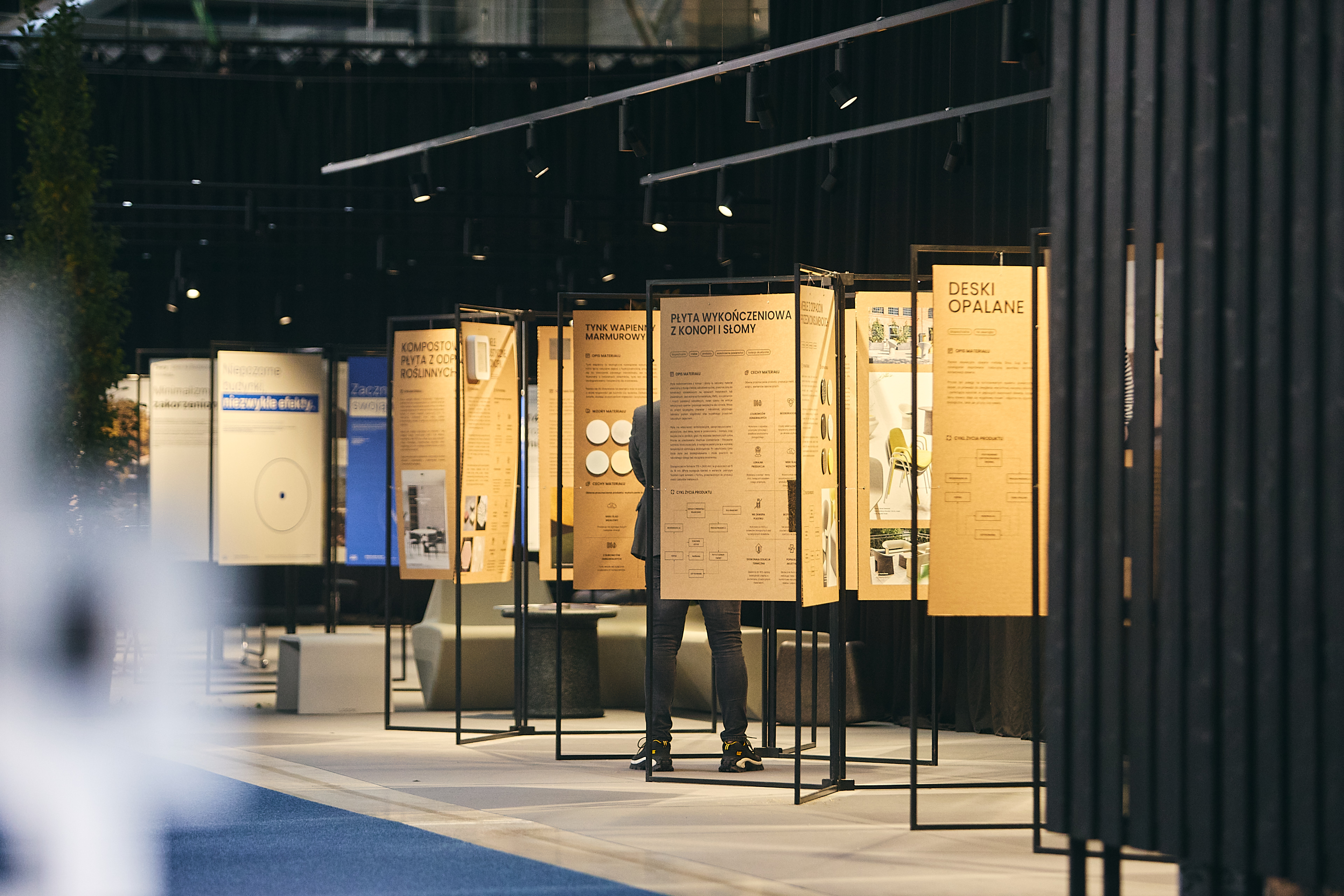
In the face of climate change and escalating environmental challenges, the fields of architecture, design, and construction are at a crucial turning point — they must evolve. The exhibition “Materials Ready for the Future” proves that this transformation is not only necessary but entirely possible. It showcases a new design philosophy in which materials go beyond simply reducing harm — they have the potential to actively restore balance to our environment.
The construction industry has an enormous impact on the planet, accounting for around 40% of global greenhouse gas emissions. A significant share of these comes from embodied emissions — those generated during the production of materials such as cement, steel, and aluminum. These conventional materials not only deplete natural resources but often contain toxic substances; for instance, many widely used acrylic paints include heavy metals or volatile compounds that can negatively affect human health.
That is why conscious material selection is so vital, both for the well-being of people and the planet. “Materials Ready for the Future” presents real, ready-to-implement solutions that prove a different way of building is possible. The exhibition encourages architects, designers, and decision-makers to take action — to create spaces that are healthy, regenerative, and truly built with the future in mind.



Meditation Cushion Set
Year: 2023
Brand: Wise Habit
Status: Launched
In-house Design Lead from research to production.
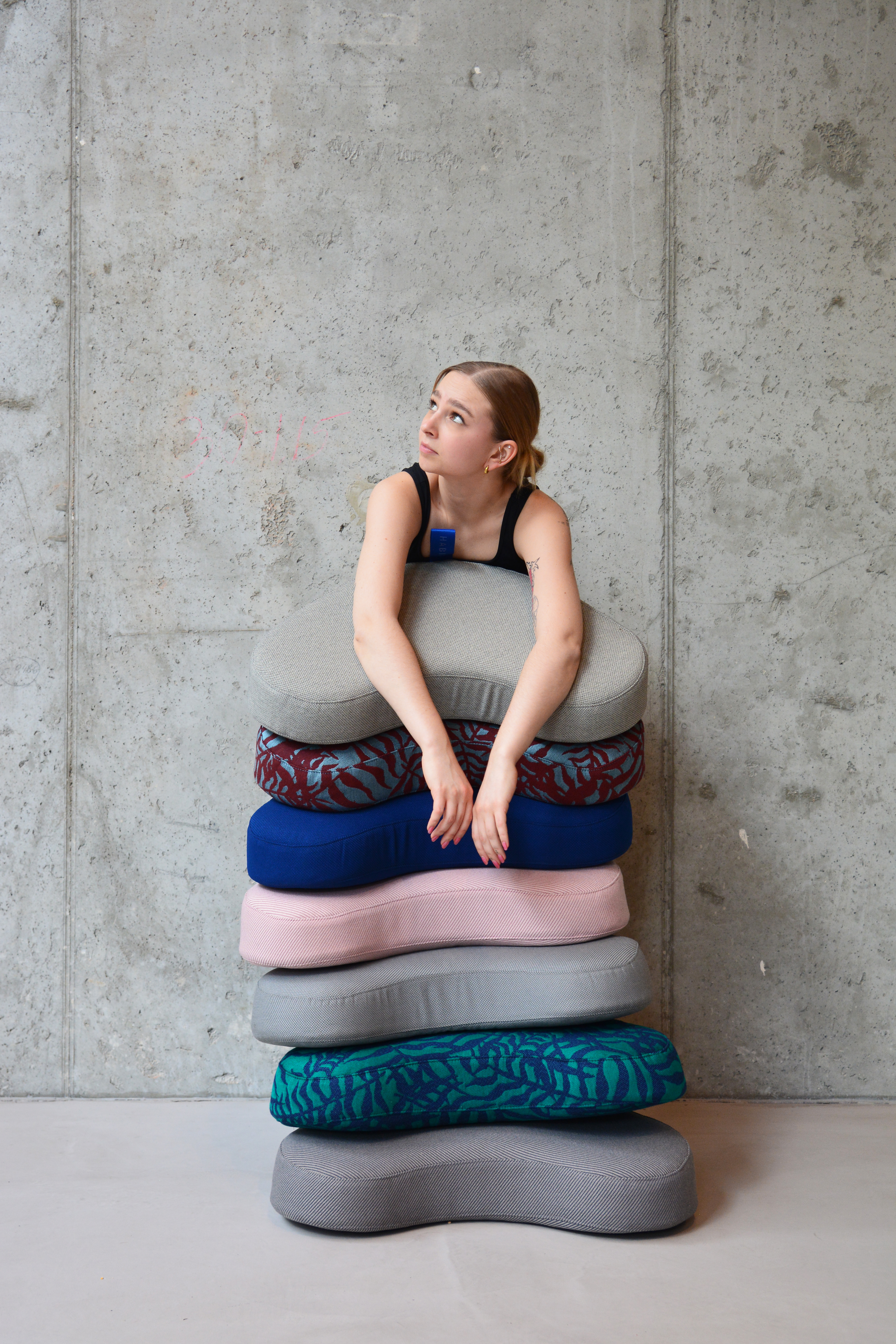
The meditation set supports comfort and proper spine alignment while remaining lightweight and easy to use. Made from coconut fibres and recycled polyester textile,
it combines functionality with a refined, home-friendly aesthetic. Removable covers and integrated handles improve usability and care.
CHALLANGE
Contemporary mobile devices are designed to capture and hold attention. Large screens, constant notifications, and social media contribute to overstimulation and reduced focus.
APPROACH
Rather than adding new features, we focused on intentional reduction. The device removes social media and limits screen-based engagement, encouraging a healthier relationship with technology. Its compact, carefully contoured form enables comfortable one-handed use. The visual language is stripped down to essentials, free from unnecessary elements and aligned with the principles of digital minimalism. Every detail—from buttons to materials and surface textures—was deliberately simplified to create a clear, calm, and purposeful user experience.
Designed for Wise Habit
Photo credits: Marzena Wolniewicz
Model: Julia Augustyniak


Base Pillow can be used on its own or paired
with the Heart of Round Pillow to provide
extra comfort during longer sitting sessions.
with the Heart of Round Pillow to provide
extra comfort during longer sitting sessions.
Heart Pillow features an angled seat position which ensures that our hips are in the correct posture for long seating sessions. The heart-like shape of the pillow provides extra comfort for knees and legs while sitting.
Round Pillow features an angled seat position which ensures that our hips are in the correct posture for long seating sessions.
Process


Wise Kitchen
Year: 2023
Brand: Wise Habit
Status: Launched
Design by Karolina Ferenc and Ryszard Rychlicki
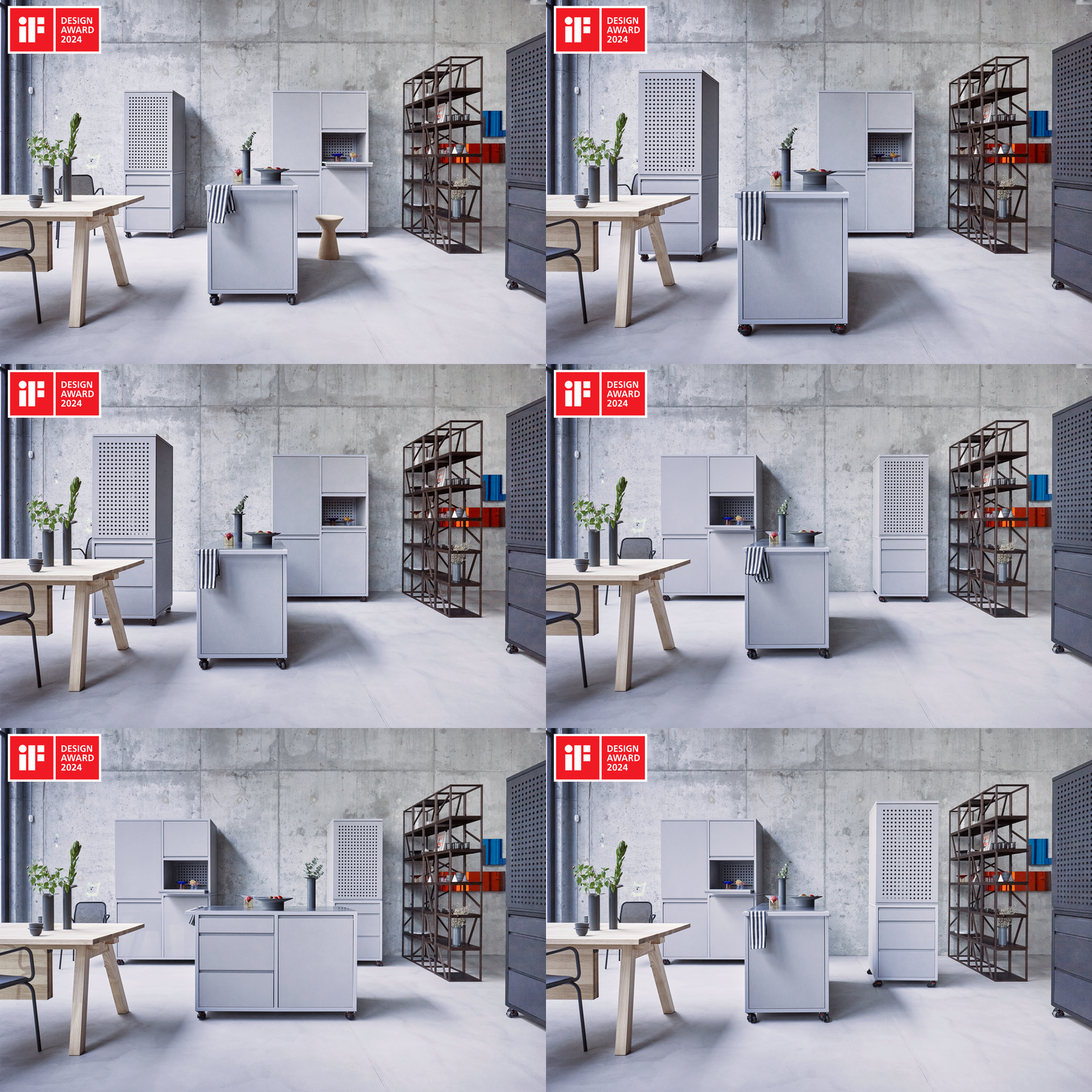
Wise Kitchen is designed as a modular, mobile and visually neutral system.
It can function as part of a traditional kitchen or stand independently in a living space, adapting to changing living situations. Built on a durable steel frame with repairable fronts and worktops from Valchromat, it is intended as a long-lasting product that can move with the user and evolve over time.
CHALLANGE
In Poland, the average lifespan of a kitchen is around 8 years, with replacement most often driven by wear and damage. The challenge was to rethink the kitchen as a durable, adaptable system that could extend its lifecycle and reduce the need for replacement.
APPROACH
The design is based on a robust frame structure with replaceable elements. Valchromat was used for fronts and surfaces due to its durability, repairability, and sustainable properties. Individual components can be repaired or replaced without discarding the entire kitchen. A restrained form, neutral color palette, and simple detailing allow the system to fit a wide range of interior styles.
Photo credits: Bind-Up Photo
Background
The first kitchen unit was designed for the Wise Habit Concept Store—a showroom and multifunctional space used for meetings, work and storage. The goal was to create a modular kitchen that maintains a clean, organized look without requiring constant upkeep,while blending seamlessly into a more formal, non-kitchen environment.
Designed for flexibility, the unit is mobile and can be easily rearranged. The sink and countertop are hidden behind doors, allowing everyday kitchen use to disappear and the space to quickly shift back to a meeting or work setting
After we noticed the first kitchen designed for the showroom purpose is very useful and very popular among visitors, we decided to investigate this subject further. Our main inspiration was Frankfurt Kitchen designed in 1926 by Austrian architect Margarete Schütte-Lihotzky. Her revolutinary approach started with looking at the kitchen as an object, piece of prefabricated furniture instead of fixed space, a room in the house. It means she rationalised traditonal kitchens design by shrinking its size, miximizing space usage and focusing on efficiency.
Development
The next iteration of our product focused on examining the needs of our users, which we translated into dimensions, bulit-in equipment and arrangement variations. As a conclusion we developed kitchen island, single and double high units with option to combine them in three or four units. We added perforation for more playfull and light apperance of the product. We use the same material for front and back walls in order to make our kitchen units freestanding. Arranged elements are placed on levelling wheels which allows to set the kitchen on any type of flooring. At this stage, we started checking the possibility of producing a flat pack version of the product.


Elements and configurations